


RenHverdag
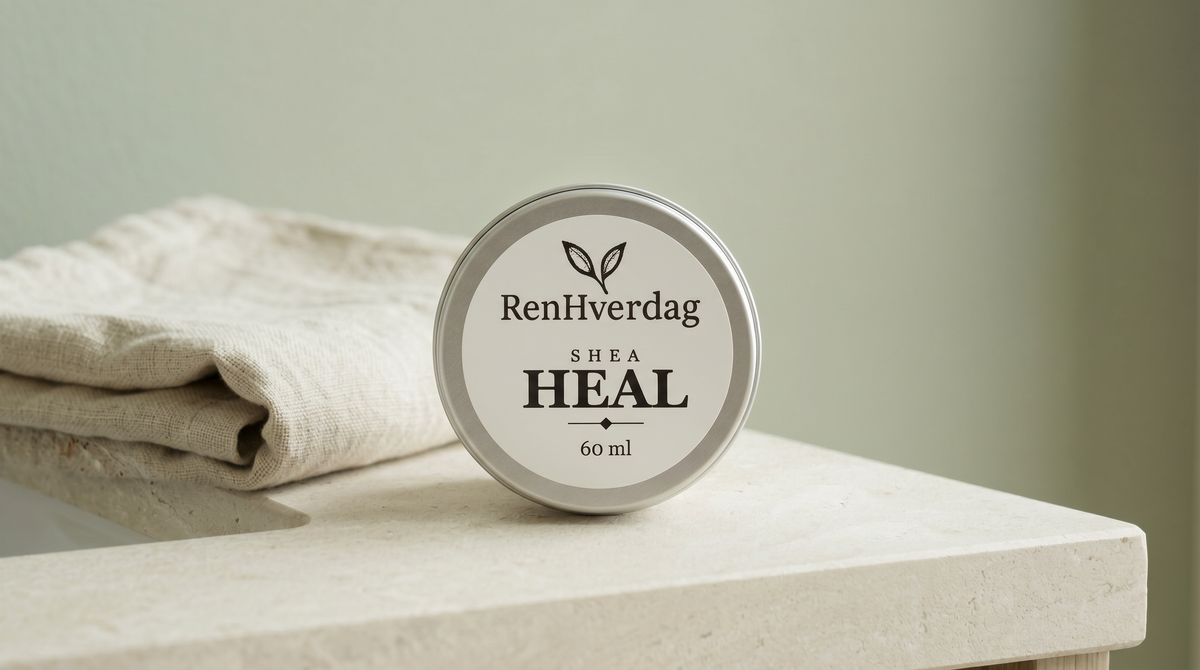
Shea Heal
Shea Heal
Ingredients (INCI)
Butyrospermum Parkii Butter (unrefined organic shea butter), Squalane (olive-derived — mimics the skin's own lipids), Calendula Officinalis Flower Extract (calendula extract — CO2-drawn, the single active in this one), Tocopherol (vitamin E — an antioxidant for the skin, and keeps the fats fresh)
The names are in Latin because the law requires it. No Aqua on the list — there is no water in it.
Couldn't load pickup availability
Sensitive skin rarely reacts to nothing.
Perfume, essential oils, preservatives, colourant. Those are usually the troublemakers.
Shea Heal is built by leaving them out. Sensitive skin is often confused enough already. What's left is the clean base and one active: calendula.
The extract is CO2-drawn — one gram corresponds to roughly twenty grams of the dried flower. It gives the butter a golden colour. That's the flower's own.
For skin after sun, after travelling, after a week that was too much. Also for the smallest ones, from three months.
60 ml.
Made by hand.

Collapsible content
Water-free — and why
No water. It sounds simple, but it changes everything: without water there is nothing to preserve (so no preservative), nothing to bind (so no emulsifier), nothing to dilute it with.
The whole jar works. You aren't putting diluent on your skin — 60 ml is 60 ml of product.
Plant-based all the way: shea and squalane (derived from olives). No animal fats.
Why shea — and why unrefined
Where our shea comes from: 100% cold-pressed, wild-harvested shea butter from Ghana — FairTrade and socially responsible production.
The raw material is certified natural cosmetics and comes from a cruelty-free certified producer.
Shea has an unusually high unsaponifiable fraction — the part of the fat that isn't ordinary fatty acids, but bioactive triterpene esters, phytosterols and natural tocopherols. Where most plant oils sit at around 1 %, shea sits many times higher. That is shea's real signature — chemically documented, not a marketing word.
Other products add an unsaponifiable fraction as a line on the ingredient list. In shea it is already there — from the raw material itself.
Shea carries a genuine West African history — used for over a thousand years, and one of the few raw materials controlled by women. And despite its origin as a tree nut, shea is remarkably low-allergen: it contains none of the proteins that trigger nut allergy.
What is squalane?
Squalane is a skin-identical lipid.
Squalene makes up around an eighth of the skin's own sebum; squalane is the stable form that doesn't go rancid. It makes the butter lighter and less greasy — without us adding a soft oil that could turn rancid in the jar.
It costs more than ordinary plant oils. We use it because it is stable and kind to skin, not because it is cheap.
Our squalane is derived from olives. It is non-comedogenic — it doesn't block pores — and suits all skin types.
Why a CO2 extract rather than a pressed oil
Many botanical "actives" are really pressed oil — diluted, where only a small part is the working ingredient. We use a CO2 extract instead: the raw material drawn out with CO2 under pressure, which evaporates without a trace and leaves zero solvent.
The result is a concentrated, clean active fraction — dosed precisely, not bulked out with foreign oil. It costs more to make. It is also why a small amount is a real dose and not a sprinkle for the label.
Note: SHEA REN deliberately contains no extract — only the clean three-ingredient base.
It is RENEW (pomegranate seed) and HEAL (calendula) that add a single active, both as CO2 extracts. If you want an active in your butter, those are the ones to look at.
The full INCI is at the top of the page, above the buy button.
About the scent
All our shea body butters are unperfumed — we add no fragrance. But unperfumed isn't the same as scent-free: unrefined shea butter has its own natural, mild nutty smell with a discreet earthy note.
That's why ours smells mild. Our shea is cold-pressed — without added heat, water or chemical solvents. It is precisely the roasting and boiling in traditional production that develops the strong, almost smoky smell. When those steps are skipped, the butter keeps both its bioactives and a gentle scent. (We've smelled several side by side — ours is noticeably milder.)
How it behaves. The scent stays soft on you, even hours later — but close to the skin, not insistent. You notice it when you bring your skin to your nose, not in the room around you. Soft, round and rather pleasant — in our opinion.
How to use it
Take a small amount between your fingers and let the warmth melt it before you spread it. Shea turns liquid at skin temperature, so a little goes a long way — a 60 ml jar lasts a long time. Use on clean, dry skin. Can also be used on the ends of your hair.
Storage
Room temperature, dark. Not the fridge, not a hot car. It is temperature swings that make the airy structure collapse — not the warmth in itself.