


RenHverdag
Gnid
Gnid
Ingredients (INCI)
Sodium Cocoate (organic coconut oil), Sodium Tallowate (organic beef tallow), Aqua (distilled water), Glycerin (forms on its own during saponification), Kaolin (white clay — binds the grease so it clumps together), Sodium Citrate (sodium citrate — binds lime in the water)
The names are in Latin because the law requires it.
Couldn't load pickup availability
You've got a shelf of special products in plastic bottles. And the stains are still there.
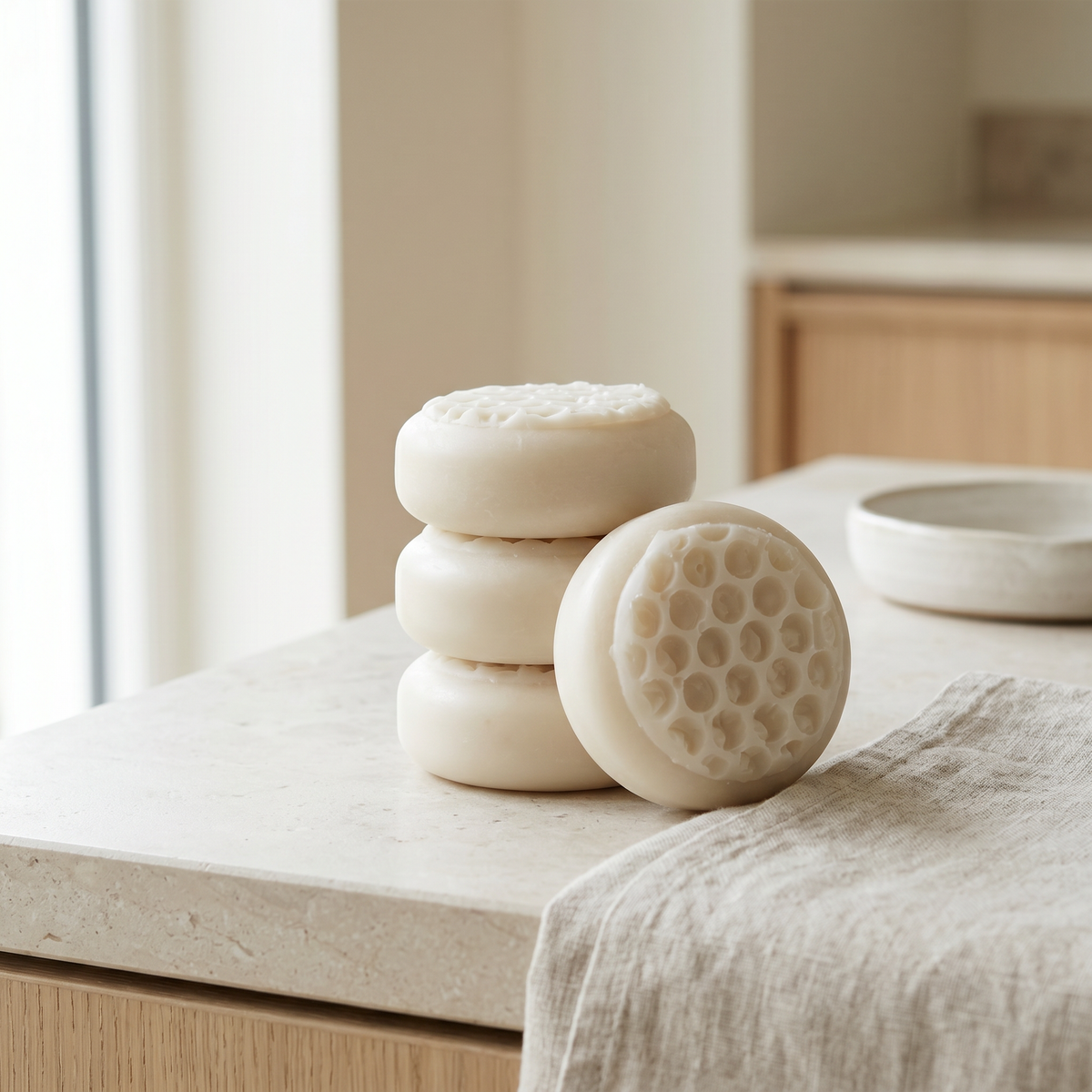
Gnid — Danish for rub — is one bar, made mainly from coconut oil. The way it was done before cleaning products were invented.
Not a body soap. A cleaning bar. It has to be wet — rub the bar straight onto the wet stain, or lather it up in water.
Things it has been used on
- A bicycle chain with two years of dried-on grease. Not fresh oil — the hard, oxidised layer.
- The sticky brown fat layer on top of the kitchen cupboards.
- Old blood, where the wash had given up.
- Two-part tile lacquer on a pair of hands. The manufacturer says themselves that it takes solvent. I wasn't the one who tested that — a customer wrote and told me afterwards. I don't own any tile lacquer.
And then the everyday: collar rims, grass stains, frying oil, white trainers that aren't white any more.
Coconut is one of the most effective natural grease removers there is.
No plastic bottle. No mixing. No fumes. No gloves.
What I use it for myself
More or less everything. Washing up, cleaning, soap flakes in the floor water. Hand-washing and soaking.
Vanish has let me down more times than I care for — and if the clothes have to go in to soak first anyway, I might as well use something I can put my hands into.
Everything above I've tried myself. Apart from the tile lacquer.
Made by hand.

Collapsible content
How to use it
The principle is always the same: wet it, rub Gnid straight onto the stain or the grease, let it sit for a moment — then rinse or wash. The contact time is what does the work.
Stains in clothes — collar rims, yellowing from sweat, grass, foundation, food. Wet the stain, rub the bar directly on until there's a thick paste, and work it in with your fingers or a soft brush. Let it sit 5-10 min. Wash as normal.
Grease and oil — chain grease, motor oil, splashes of cooking oil. Wipe off the worst first. Wet, rub directly on, and let the coconut degreaser break the grease. Rinse or wash. Repeat on the heavy stuff.
Kitchen — pots, dishes, baked-on oven grease. Wet a brush or a sponge, rub it against the bar until there's lather, scrub in circles. Not on cast iron.
Trainers and white soles — wet, lather on an old toothbrush, scrub the sole and the edge, wipe off with a damp cloth.
Dirty hands — oil, soil, paint. Lather between your hands and rub thoroughly. It takes hold where hand soap gives up.
Check first — not on wool, silk or other protein fibres, and not on wine, coffee, tea, rust or ballpoint pen. Test a hidden corner on delicate things.
One bar — many bottles
Stain remover. Degreaser. Pre-wash spray. Washing-up liquid. Oven cleaner. Trainer cleaner. More bottles, more hazard symbols, more ingredient lists you can't read — and half of it is water.
Or one bar, wrapped in a piece of tissue paper for hygiene. It can go in the paper recycling. No plastic bottle, no spray bottle. Without the water that's been driven across the country in a lorry. Without the cocktail of surfactants, solvents and perfume it takes to keep a spray liquid — and without the mist of all of it that you spray into the air and draw into your lungs.
Turn a bottle of degreaser around. Read the warnings. Count the hazard symbols.
Storage
Keep Gnid dry between uses. A soap dish that drains or a sisal pouch — anything that lets the water run off. The better it dries, the longer it lasts.
Gnid is a hard bar and lasts a long time — but not if it stands in a puddle by the sink.
Used it on grease or oil? Rinse the bar clean afterwards, so it's ready for the next job and doesn't carry anything over.
Ingredients
All our soaps are made in Denmark by the cold process. Fat meets lye. The fat is split. The glycerin is released and stays in the soap — instead of being removed and sold separately, as the industry does.
Never palm oil. We don't use pork fat, rapeseed or sunflower either. Not out of principle — but because the fat profile doesn't make a soap that lasts.
Every single raw material is chosen on quality, origin and function. We have the supplier spec, the INCI and the CAS number for all of them — and we choose the form to suit the purpose, not the dogma: unrefined where the natural content matters, refined where scent and stability matter.
You can read a great deal more about it on What's in it, where every oil, the clay, the lye and the water are explained one by one.
The full INCI is at the top of the page, above the buy button.