

RenHverdag
Rosmarin
Rosmarin
Ingredients (INCI)
Sodium Olivate (organic olive oil), Sodium Shea Butterate (organic refined shea butter), Sodium Cocoate (organic coconut oil), Sodium Castorate (organic castor oil), Aqua (distilled water), Glycerin (forms on its own during saponification), Illite (French green clay), Rosmarinus Officinalis Leaf Oil (rosemary oil), Cedrus Atlantica Bark Oil (atlas cedar), Boswellia Carterii Oil (frankincense), Limonene*, Linalool*, Geraniol*, Citral*
* Naturally occurring in the essential oils. They are on the list because the law requires it — not because they were added. The colour is the clay's own, no CI numbers.
Couldn't load pickup availability
Do you want a fresh scent — in the shower and in the kitchen?
Then this one might be for you.
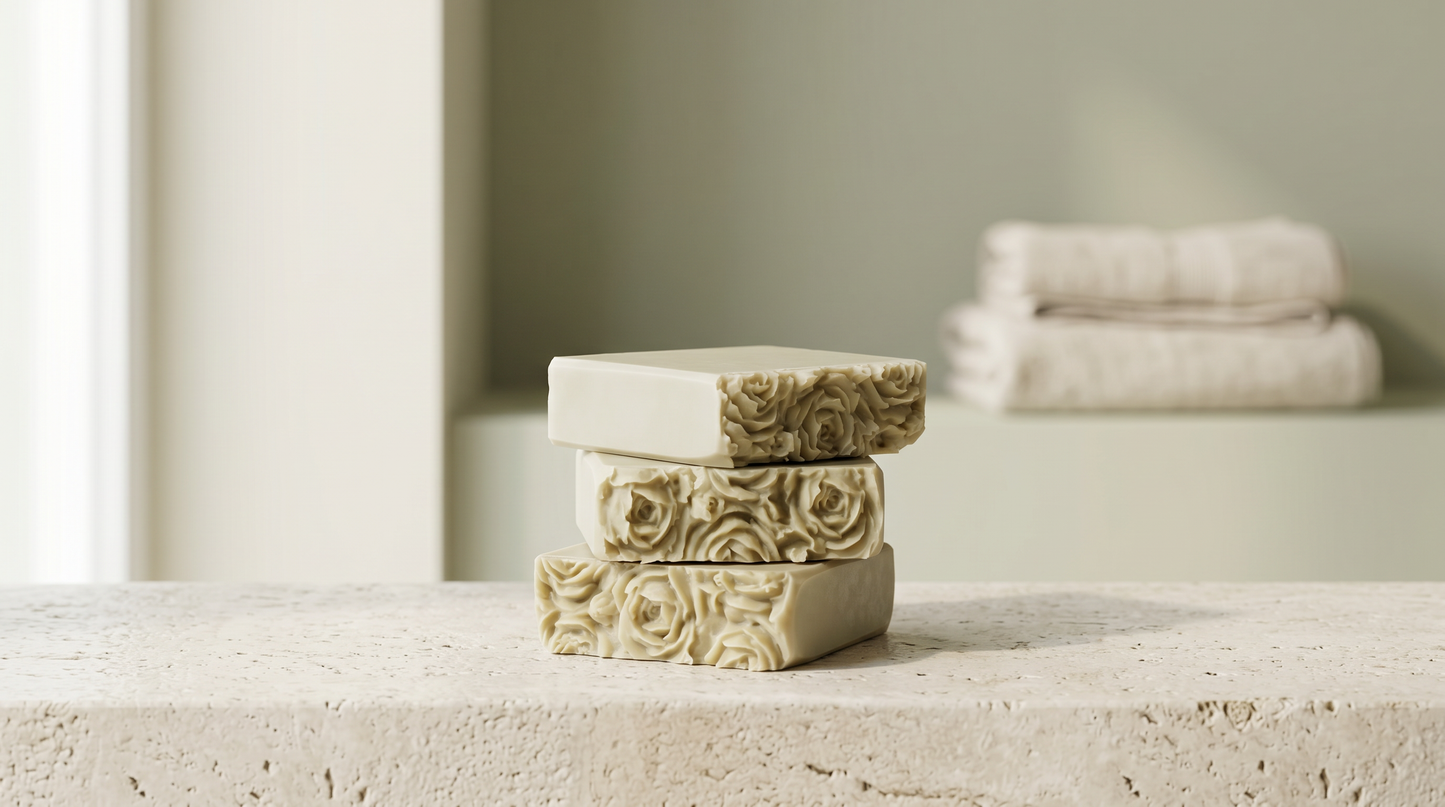
This is our vegan version with scent — for those who want essential oils and can tolerate them. It's fresher, and some say more masculine. Yes, it smells of something.
Rosemary dominates. Herbal and waking, with a warm, woody base that lingers after the shower.
No perfume.
The same base as Oliven — bastille with over 70 % olive oil, shea and coconut.
Body, hands, face, hair. And the washing-up, if the kitchen is to smell of something other than lemon.
At least 100g.
Made by hand.
Collapsible content
Can you use it on your hair?
Yes — with one step you mustn't skip.
This bar works as a hair soap. But because it's real soap, it's alkaline — and that makes the hair's outer layer lift. So you always finish the wash with a vinegar rinse, which closes the surface again and gives the hair shine and movement.
The first couple of times your hair may feel different while it gets used to being without the substances that normally settle as a film. The vinegar rinse is the whole difference.
How to do it:
- Wash your hair with the bar, or lather it in your hands and massage into the scalp.
- Rinse thoroughly.
- Mix 1 tbsp vinegar (ordinary or apple cider) into half a litre of water. Pour it through your hair as the last rinse.
- Rinse lightly with clean water if you like — the vinegar smell disappears as the hair dries.
Don't want to mix it yourself? Our ACV leave-in does the same — it just stays in the hair, so you neither measure nor rinse.
Very short hair? Then you can skip the vinegar rinse if you want. It's with longer hair that the alkalinity really shows — which is why most men and very short-haired people manage fine with just the bar and water.
What you get
You're free of unnecessary chemistry and of plastic bottles.
Many people find their hair lighter — especially after a soap with Kul.
If you want to understand why hair has to be \"reset\", and what happens along the way, you can read more here


How to use it
Hands — wet your hands, rub the bar between them until there's lather, wash, rinse.
Face — lather in your hands first. Not the bar straight onto your face. Wash with the lather.
Body — lather in your hands or on a cloth. Use all over.
Shaving — lather up and apply straight to the skin. Enough glide to shave without extra products. Use a shaving brush if you have one. It gives thicker lather.
Washing up — wet a dish brush and rub it in circles against the bar. That's enough lather for one round. Or a scourer, or a microfibre cloth. Yes, it works.
One bar — many bottles
Hand soap, body wash, face wash, shaving foam. More products, more plastic bottles, more ingredient lists you can't read.
Or one bar, wrapped in a piece of tissue paper for hygiene. It can go in the paper recycling. No plastic, no pump, no bottle to rinse out. Without the excess water that's been driven across the country in a lorry. Without the 20+ ingredients it takes to keep a liquid soap liquid.
Turn a bottle of liquid soap around. Read the ingredient list. Count the words you can't pronounce.
Storage
Keep the soap dry between uses. A soap dish that drains, or a sisal pouch.
Air the bathroom out after each use. Glycerin draws moisture from the air — good for your skin, bad for your soap if the room is always steamy. The soap needs to breathe. So no plastic bag for any length of time either.
That goes for both kinds. The better it dries between uses, the harder it gets, and the longer it lasts. A soap lying in a puddle uses itself up.
Beef tallow or olive
That's entirely up to you. Both do exactly the same — hair, face, hands, body, washing up.
The difference isn't what they can do, but what you prefer: how the lather and the glide feel, during and after. Some swear by one, some by the other. Your own preferences decide — ethical, skin-related, or something else entirely.
Beef tallow — not vegan. Viking. A hard bar. The fatty acids — palmitic and stearic — are the same ones the skin produces itself. The lather comes quickly and is full. And it's economical.
Olive — vegan. Built on a bastille recipe: over 70 % olive oil. A completely different feel, during and after. The lather is creamy rather than bubbly and feels extra smooth against the skin.
Both kinds have washed whole cultures for hundreds of years. The difference was geography — Scandinavia had no olive groves.
Both need to sit dry between uses.
Ingredients
All our soaps are made in Denmark by the cold process. Fat meets lye. The fat is split. The glycerin is released and stays in the soap — instead of being removed and sold separately, as the industry does.
Never palm oil. We don't use pork fat, rapeseed or sunflower either. Not out of principle — but because the fat profile doesn't make a soap that lasts.
Every single raw material is chosen on quality, origin and function. We have the supplier spec, the INCI and the CAS number for all of them — and we choose the form to suit the purpose, not the dogma: unrefined where the natural content matters, refined where scent and stability matter.
You can read a great deal more about it on What's in it, where every oil, the clay, the lye and the water are explained one by one.
The full INCI is at the top of the page, above the buy button.